Between Symbol and Matter
The artist’s earlier works were based on a synthetic form — the author reduced the subject to the level of a sign, exploring where the boundaries of readability lie when a message is reduced to a synthetic (and often symbolic) form.
In his most recent works, the artist shifts the center of gravity toward painterly matter. The painter is fascinated by the fact that an image functions simultaneously on two scales: macro and micro. One can therefore interpret the work as a whole, but it is also possible to “read” it through its fragments. These fragments may function as entirely autonomous painterly worlds, with their own extraordinary intensity and power of attraction.
Perhaps one of the artist’s aims is to show that the number of these “paintings within the painting” is in fact infinite, and that the decisive factor influencing the reception of the work remains the painterly structure and the distance from which it is viewed. The key elements are therefore the qualities of this structure: interpenetrating painterly values, their appropriate density, and saturation with “information.” This way of looking at a painting may resemble traveling with one’s eyes across a map, where the number of possible routes is virtually inexhaustible. Painterly matter gives the painting its tone, an individual vibration, influencing the perception of the work as a visually and conceptually multidimensional phenomenon.
The artist works based on a constantly evolving, proprietary technology that he himself describes as “archaeological painting.”
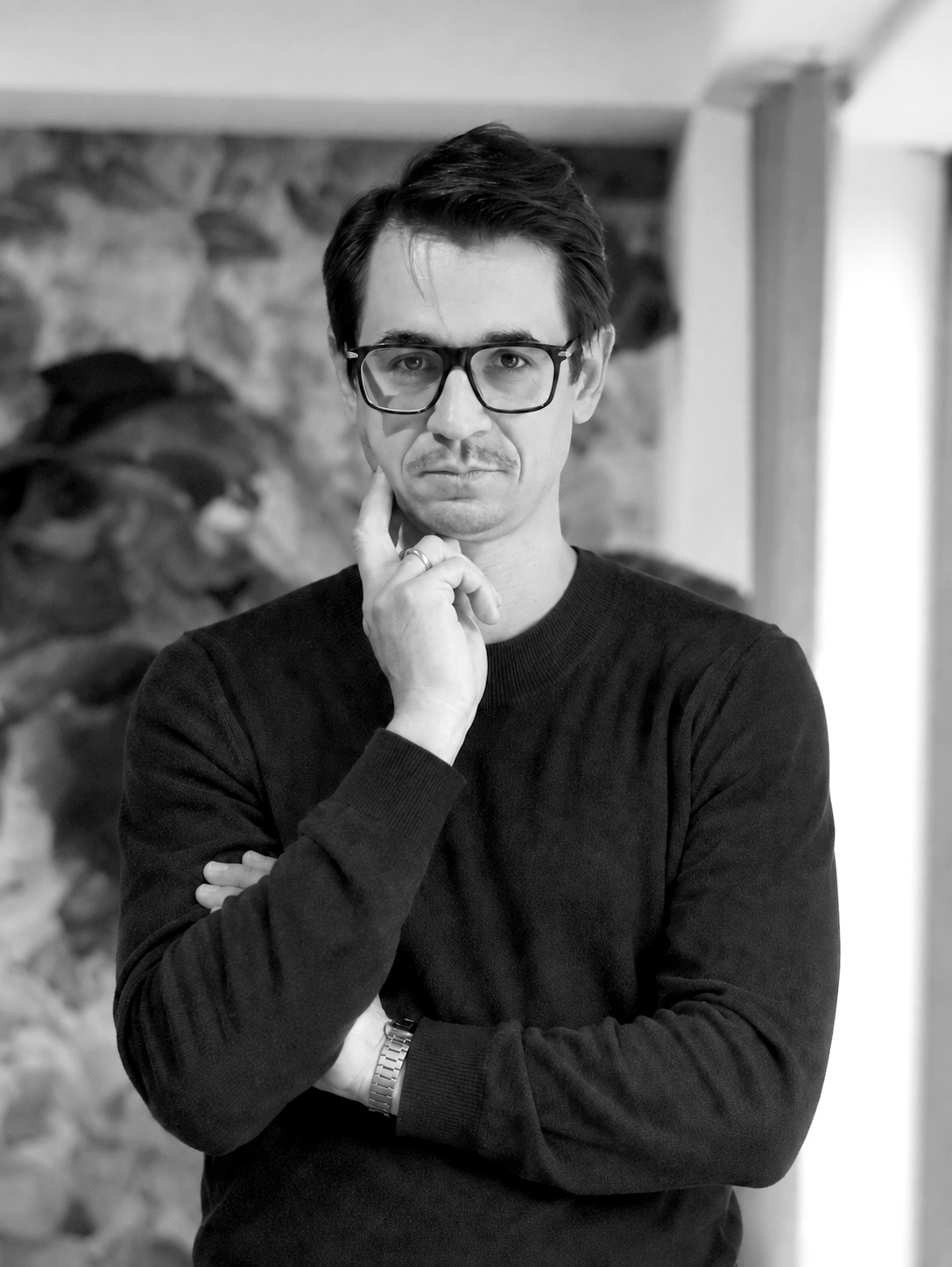
Jakub Margasiński is a graduate of the Faculty of Painting at the Academy of Fine Arts in Kraków. He defended his diploma in 2009 in the studio of Professor Grzegorz Bednarski.